Language Settings
Select Website Language
newshunt
newshunt

Filters

Channels
Topics
Other Filters

Samsung Galaxy S26 Ultra Launched With Built-In Privacy Mode: Check Price & Features

Samsung Galaxy S26 Ultra Launch: If the regular S26 impressed you, wait till you look at this one. Samsung has officially launched the Galaxy S26 Ultra at the Galaxy Unpacked 2026 event in San Francisco. This is the top-end model in the lineup and clearly the most premium one. And this time, Samsung is not just talking about the camera or performance.  The spotlight is on something completely different: the newly built-in Privacy Display. Along with that, you also get a powerful camera setup, strong performance and smarter AI features. Samsung Galaxy S26 Ultra Price In India Samsung Galaxy S26 Ultra is priced at Rs 1,39,000 for the 12GB + 256GB variant, while the 12GB + 512GB model is priced at Rs 1,59,999. Furthermore, the top-end 16GB + 1TB storage variant is listed at Rs. 1,89,999.  Samsung Galaxy S26 Ultra Features/Specifications: Privacy Display, Camera, Performance, More Now let’s talk about the main highlight. Galaxy S26 Ultra introduces a built-in Privacy Display. This is not a screen guard or an add-on accessory. It is integrated into the display hardware itself.  With a quick toggle, the viewing angles narrow down, so people sitting beside you cannot clearly see your screen. At the same time, you still get proper brightness and colour when looking at the phone directly. The device is also just 7.9mm thin, making it the slimmest Ultra so far. Coming to performance, Galaxy S26 Ultra is powered by the Snapdragon 8 Elite Gen 5 Mobile Platform for Galaxy. Samsung says it delivers its best performance yet. The phone also supports Super Fast Charging 3.0 and can reach up to 75% charge in just 30 minutes. Now let’s come to the camera. Galaxy S26 Ultra features a 200MP wide camera, 50MP ultrawide camera, 50MP periscope lens and a 10MP telephoto camera.  Samsung has improved low-light photography with wider apertures and better Nightography Video. The upgraded Super Steady feature also helps in capturing stable videos. Talking about AI features, Galaxy S26 Ultra comes with upgraded Bixby and features like Now Nudge, Now Brief and enhanced Circle to Search. Security features like Private Album and long-term OS updates are also part of the package.

Pills, Pain And A Wager: Shoaib Akhtar Opens Up On What He Did To Get Sachin Tendulkar Out: WATCH

Former Pakistan fast bowler Shoaib Akhtar has offered a revealing account of the intensity that marked 1990s India–Pakistan cricket, recalling a private wager with Saqlain Mushtaq over the prized wicket of Sachin Tendulkar. The episode dates back to Pakistan’s 1998-99 tour of India, a two-Test series remembered as one of the most gripping contests of that period. The Chennai Test, in particular, remains etched in memory for Tendulkar’s fourth-innings 136 and Pakistan’s narrow victory. Against that backdrop, Akhtar’s recollection of a bet over who would dismiss Tendulkar reflects not merely dressing-room banter, but the internal competitiveness within a formidable bowling attack during a series of high emotional and tactical stakes. The Wager Over Sachin’s Wicket Akhtar said the contest began after Saqlain’s repeated success against Tendulkar in the series. “When Saqlain had already got so many wickets, in Chennai and here in Delhi too, Saqlain and I made a bet. He said, I have to get Sachin out, that’s what I’ve been doing. I said, No, I’ll do it this time, it’s my turn," said Akhtar. Has Shoaib Akhtar just admitted to doping on LIVE Showpic.twitter.com/q6bTSVzUyg — Cricketopia (@CricketopiaCom) February 24, 2026 In that era, Tendulkar’s wicket was more than a breakthrough; it was a matter of personal pride. For bowlers sharing the same attack, dismissing him was a defining achievement. Playing Through Pain Akhtar’s account then shifts from rivalry to the physical toll behind the scenes. “ Fluid was being drained from my knee, and I was getting injections, just so I could play the match." Delivered without embellishment, the line underscores what it took for elite bowlers to remain match-ready during such high-stakes contests. He further revealed that Saqlain was battling his own fitness issues. “His knees had gone in 1996, and mine gave way in 1997 in front of him. And now both of us were secretly taking pills and injections, just to be able to play the match." The recollection presents a picture not only of competition, but of endurance, two bowlers pushing through pain while trying to outdo each other. Pressure Beyond The Scoreboard Akhtar also described the selection pressure surrounding injuries during the series. “If one of us went out of the series, then Saqi would be out too, and I was already under the gun anyway, like, don’t let this one go." The phrase “under the gun” conveys the scrutiny and expectation that accompanied performance and fitness alike. In that phase of India–Pakistan cricket, a spell, a wicket or an injury could alter reputations as much as results. More Than A Memory While the anecdote centres on a bet to dismiss Tendulkar, it also captures the broader intensity of the rivalry. Performance, pride and physical sacrifice were tightly intertwined, making even an internal contest within the team a measure of resilience and resolve.

‘What Use Is Tech Talent Without Civic Sense?’ Kiran Mazumdar-Shaw Sparks Debate Online

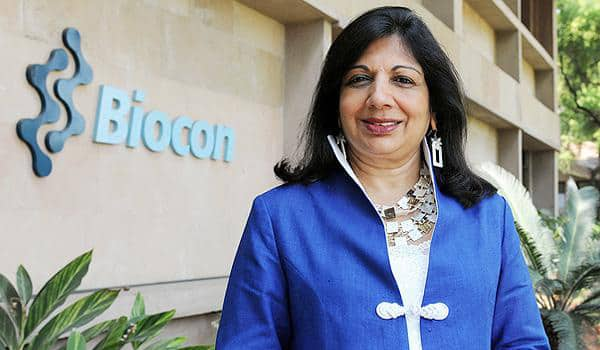
Biocon founder Kiran Mazumdar-Shaw has triggered an online debate after questioning why India’s technology talent cannot be deployed to address basic civic problems. In a post on X, the biopharmaceutical entrepreneur wrote, “What use is tech talent without civic sense? Can’t we use technology to keep our city clean, to discipline our traffic and improve infrastructure? If China can use robots to collect garbage, clean sewers n control traffic offenders, why can’t we? Come on techies rise to the challenge - waste to wealth n to a clean and green city.” Social Media Divided Her remarks quickly went viral, drawing sharply divided responses on whether technology alone can resolve civic challenges or whether governance and behavioural change are more critical. What use is tech talent without civic sense? Can’t we use technology to keep our city clean, to discipline our traffic and improve infrastructure? If China can use robots to collect garbage, clean sewers n control traffic offenders, why can’t we? Come on techies rise to the… — Kiran Mazumdar-Shaw (@kiranshaw) February 25, 2026 Some users argued that civic problems extend beyond technological solutions. “Anything to do with gov is the hardest thing to navigate for a ‘techie’. Also not everything is a tech problem. Tech cannot make humans behave. Cleanliness, not being corrupt etc cannot be handled by building tech,” one person wrote. Another pointed to social habits. “The key is not cleaning up first is to stop the littering culture ! Learn from Japan starts fm cleaning home toilets schools and no one litters ! No garbage bins ! Aging population very limited municipal workers who only collect organised bags not clean!” the user commented. “This is incredibly surprising. A well respected business leader asking techies to solve for political corruption and bad governance? Things will change when influential people start questioning the Govt, not the Techies. But alas! Very surprising,” remarked another. Support For A Tech-Driven Approach Others backed Mazumdar-Shaw’s call for innovation-led civic reform. “Tech talent isnt just for startups and unicorn valuations it should fix the streets we actually live on. Smart sensors for waste, AI traffic enforcement, civic apps that actually work… the solutions exist. What’s missing is intent + execution. Clean cities wont come from speeches, they’ll come from builders. Time to code for the country, not just for funding,” one user wrote. Another added, “Spot on! Techies can build apps for smart bins, AI traffic cams like China’s — let’s make our cities clean & green!” “We build world-class code, yet struggle with basic civic order. The challenge is integration, not invention. Worth serious reflection,” expressed another.

Samsung Galaxy S26 Ultra First Impressions: Showstopping Privacy Display, Done Smartly

Samsung Galaxy S26 Ultra First Impressions: Every year, there is that one feature that tries to steal the spotlight. More megapixels. More zoom. More AI. But with the Galaxy S26 Ultra, Samsung has chosen a different hero. It is not the camera. It is not the chipset. It is the much-hyped industry-first Privacy Display. And no, this is not just another privacy screen guard you awkwardly stick on and regret later. Let’s dive in. Not Yet Another Screen Guard The display is actually on in this photo, can you tell? We have all seen those matte privacy protectors that darken your screen, kill brightness, and make your flagship look like a budget phone from a decade ago. And I must admit, I did think that the Korean tech giant has just come up with a fancy-schmancy version of privacy stickers. Happy to say that I was very, very wrong. Samsung’s inbuilt Privacy Display is integrated at the hardware level. A display, as you already know, is made of thousands of mini LEDs that emit light. A regular display (or for that matter, all other displays on every single phone out there right now), has LEDs that throw light in a wide angle, which means a bigger FoV for you and the peeping tom near you. Samsung did something smart and chose to programme the LEDs to selectively emit narrow light, reducing the FoV by a great extent. With a quick toggle, the screen narrows its viewing angles, making sure wandering eyes from the side seats see… well, almost nothing. But you, the primary user, still get brightness, colour accuracy and sharpness without compromise. And the best part? Since the phone can now programme individual LEDs, you can have your entire screen visible, but certain portions of the display, such as sensitive notification pop-up, PIN/gesture zones, or even particular apps, to get the Privacy treatment. This works almost like magic. The person standing next to you can see your screen just fine, but should a senstive WhatsApp message pop up, that would conveniently be visible only to you, standing right in front of the display, and not anyone else on the side. Pretty ingenius, this. Certainly starting a trend that's sure to be replicated by almost all upcoming phones now. Or atleast, it should! Classic Ultra, Dialled Up Design-wise, Samsung is not reinventing the wheel. The Galaxy S26 Ultra carries forward its sharp, confident silhouette. Flat edges, premium finish, and that unmistakable Ultra presence. It feels solid, expensive.  The Galaxy S26 Ultra has a thickness of just 7.9mm, making it slightly lighter than the previous generations as well.  The display remains expansive and immersive, built for binge sessions, multitasking and serious productivity. The inbuilt S Pen experience continues to make this the go-to device for note-takers, doodlers and spreadsheet warriors alike. Under the hood, expect top-tier performance (thanks to a specially tuned Snapdragon 8 Elite Gen 5 SoC) and AI-led features that promise to handle everything from photo edits to productivity tasks without breaking a sweat. But those deserve a deeper dive in our full review, coming soon! Cameras, Power, The Ultra Identity Of course, this is still an Ultra. Which means a serious camera system (200MP wide + 50MP ultrawide + 50MP presicope + 10MP telephoto) designed to compete with the very best from Apple and Google. Early shots look sharp, detailed and social media ready, with that signature Samsung punch. Battery life, with a 5,000mAh unit, should be ample for a day's usage. This is a phone built for heavy users who do not want to hunt for chargers by late evening. But here is the thing. For once, the headline feature is not about showing off to others. It is about protecting what is yours. Samsung Galaxy S26 Ultra: Early Verdict After spending some time with the Galaxy S26 Ultra, one thing is clear. The Privacy Display is not a gimmick. It is not a glorified screen protector. It is a thoughtful addition for a world where our phones hold everything from banking apps to deeply personal conversations. The Galaxy S26 Ultra feels powerful, polished and predictably premium. But its real flex this year is subtle. More in ABP Live’s detailed review soon.

Samsung Galaxy S26, Galaxy S26+ First Impressions: Sticking To Tried-And-Tested Formula, But No 'Wow' Factor

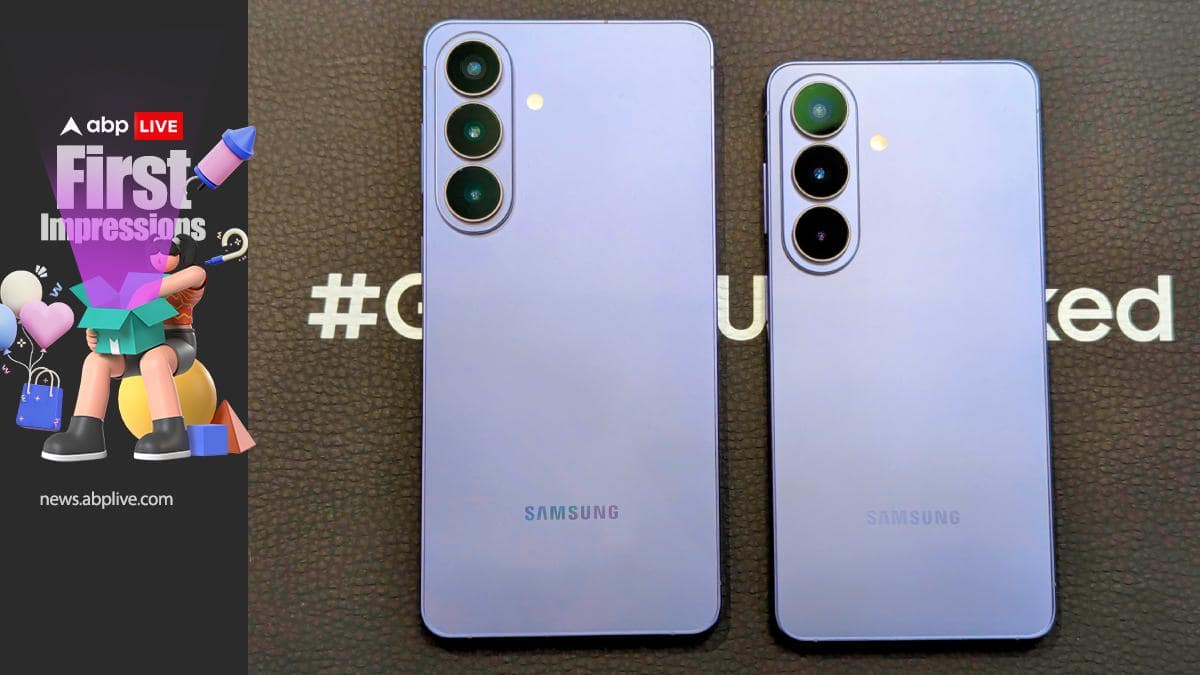
Samsung Galaxy S26, Galaxy S26+ First Impressions: Samsung has just announced its 2026 flagship lineup, the Galaxy S26 series, which comprises three models: Samsung Galaxy S26, Samsung Galaxy S26+, and Samsung Galaxy S26 Ultra. While the Korean tech giant has gone all out on the top-end Galaxy S26 Ultra, which has set he bar high with its industry-first inbuilt privacy display feature, the same cannot be said for the vanilla Galaxy S26 or the mid-tier Galaxy S26+. However, if you like Samsung phones or are looking to upgrade your older model from a couple generations ago (or even looking to switch from any other brand to this one), fret not, as the Galaxy S26 series are genuinely great phones. Just that big brother Ultra simply outshines. Let's take a closer look at the Galaxy S26 and Galaxy S26+.  Sticking To The Classics See, I've always liked Samsung's no-nonsense design language. Almost every one uses covers anyways, so how your phone will look like will eventually depend on your taste in back panels. If you compare the S25 series and S26 series side by side, you may not be able to differentiate between the two. Is that a bad thing? Depends on where you stand. The Galaxy S26 comes with a 6.3-inch Dynamic AMOLED display while the Galaxy S26+ sports a 6.8-inch one. The latter is marginally smaller than the top-end Galaxy S26 Ultra. Both the phones feel good in hand. They don't feel super slippery, and they do feel well-balanced, which is always appreciated. However, as the headline suggests, there is no 'wow' factor in the overall design language that would make you stand back in awe. Understand this, the Galaxy S26 and the Galaxy S26+ are your workhorses. They are designed to feel familiar and get your tasks done in a jiffy. With a plethora of AI-led features inside, these two phones are sure to stand up to the occassion when the need arises. But more on that in ABP Live's detailed review later on. The optics remain the same for both phones as well. The Galaxy S26 and the Galaxy S26+ come with a 50MP wide, a 10MP telephoto, and a 12MP ultrawide camera, delivering you great photos, when you compare with other premium phones such as the iPhone 17 or the Pixel 10.  What About The AI Features? Let’s talk about the brains inside this familiar shell. With a nifty little feature called Now Nudge, Samsung wants your phone to feel less like a device you constantly manage and more like an assistant that quietly keeps up. The idea is simple: timely, relevant suggestions that pop up when you actually need them, not when you are trying to focus on something else. It works sort of like the helpful nudges we get on stock Android OS on Google's own Pixel phones, but this has an 'agentic' touch to it, trying to be that eager little beagle who would love nothing better than to help make your life better. Then there’s the upgraded Bixby, now positioned as a proper conversational device agent. And no, this is not the old “tap, repeat, correct command” routine. You can now speak in natural language and adjust settings or navigate your phone without memorising exact phrases. Samsung has also doubled down on AI editing tools. Expect smarter photo and content edits that do more of the heavy lifting for you. On top of that, you get real-time features like Now Brief and an enhanced Circle to Search, making quick lookups and contextual actions even more seamless. Integration with agents like Bixby, Gemini and Perplexity goes deeper this time, turning the Galaxy S26 into a bit of a multi-assistant powerhouse. If you have anything older than the Samsung Galaxy S24 series or any other phone at least 2-3 years old, the new Samsung Galaxy S26 and Galaxy S26+ is well worth the upgrade. 

Samsung Galaxy Buds 4 Pro First Impressions: Edgier & Transparent, With Fun Gesture Controls To Boot

Samsung Galaxy Buds 4 Pro First Impressions: Samsung has just released its flagship lineup for 2026, the Galaxy S26 series, and along with it, we got our hands on the latest earbuds from the Korean tech giant. The Samsung Galaxy Buds 4 Pro has done away with lots of its previous-gen baggage and genuinely feels like a brand new product, espeically if we talk about design elements. So, without further ado, here are my first impressions on the Galaxy Buds 4 Pro. All-New Case, All-New Attitude With the Galaxy Buds 4 Pro, Samsung has finally ditched its standard (read: AirPods-like) charging case and has come up with a more compact cupcake-box design. Why cupcakes? If you have ever purchased cupcakes from premiuim boulangeries, you'd know how the box comes with a transparent lid, with the creamy goodies beckoning from inside. The Galaxy Buds 4 Pro case feels similar.  It has a transparent lid, which opens wide and snaps shut with nice, satisfying click. And the new metallic earbuds look great sitting inside flat (instead of upright), making it much easier to take them out or place them back in.  Wondering why I mentioned 'all-new attitude'? The answer lies in the overall blade design of the buds. Let's discuss that in detail now.  Sticks To Stem, Adds Polished Metal & Fun Gestures I, for one, am glad that Samsung has decided to stick to a traditional stem design, as it makes the buds much easier to place on your ear or within the case. On the Galaxy Buds 4 Pro, there are now premium polished metal sides, with metallic grille on top, adding to the overall edgy design aesthetic. The earbud bodies come with standard sensors to detect wear and to enable other funky AI features. The tips are silicone-based, making it better suited for longer wears.  Okay so now for the fun bit: The Galaxy Buds 4 Pro comes with head gestures. Picture this, you are in the middle of an indulgent meal or an intense workout session or a overtly urgent email, and simply cannot be bothered to raise your hands to do anything. If you're wearing your earbuds, and a call comes in, all you need to do now is nod your head up and down (you know, the 'yes' gesture) and your call gets connected. On the other hand, if you don't wish to pick up the call, just nod side-to-side (the 'no' gesture) and the deed will be done. These head gestures can handle multiple tasks, more on that in our detailed review. Samsung Galaxy Buds 4 Pro: Early Verdict Based on my first few minutes fiddling with the Galaxy Buds 4 Pro, Samsung's new audio offering looks great, feels great, but does it sound great? That, dear gentle reader, shall be revealed soon in ABP Live's detailed review. For now, note this: Samsung has spared no expenses to make sure you get your money's worth out of the feels and looks columns for the Galaxy Buds 4 Pro.

Born the Day India Recognised Israel: PM Modi Highlights Personal Link In Knesset Speech

Prime Minister Narendra Modi on Wednesday addressed the Knesset, underlining the strength of India–Israel relations and drawing attention to a personal coincidence, stating that he “was born on the day India formally recognised Israel.” “Nine years ago, I had the good fortune to be the first PM of India to visit Israel, and I'm very happy to be here again, returning to a land to which I always felt drawn. After all, I was on the same day that India formally recognised Israel, September 17, 1950,” he said. Condolences Over October 7 Attack PM Modi also conveyed condolences for victims of the October 7 attack. “I also carry with me the deepest condolences of the people of India for every life lost and for every family whose world was shattered in the barbaric terrorist attack by Hamas on October 7th. We feel your pain, we share your grief. India stands with Israel firmly, with full conviction in this moment and beyond,” he said. Reference to 26/11 and ‘No Double Standards’ Policy The Prime Minister also referred to the 26/11 Mumbai attacks and reiterated India’s position on terrorism. “India has also endured the pain of terrorism for a long time. We remember the 26/11 Mumbai attacks and the innocent lives lost, including Israeli citizens. Like you, we have a consistent and uncompromising policy of zero tolerance for terrorism with no double standards. Terrorism aims to destabilise societies, to block development and to erode trust. Countering terrorism requires sustained and coordinated global action because terror anywhere threatens peace everywhere. That's why India supports all efforts that contribute to durable peace and regional stability,” he added. Netanyahu Welcomes Modi Earlier, Israeli Prime Minister Benjamin Netanyahu welcomed Modi ahead of the address, describing him as “a close friend of Israel, a strong advocate of the India-Israel partnership, and a prominent leader on the global stage.” Wreath-Laying and Public Interaction During his visit to the Israeli Parliament, Modi laid a wreath and paid floral tributes. Accompanied by Netanyahu, he greeted children waving Indian and Israeli flags and interacted with them, with several taking selfies. Modi is on a two-day state visit to Israel.

PM Modi Receives Knesset’s Highest Honour, First Indian PM To Be Awarded

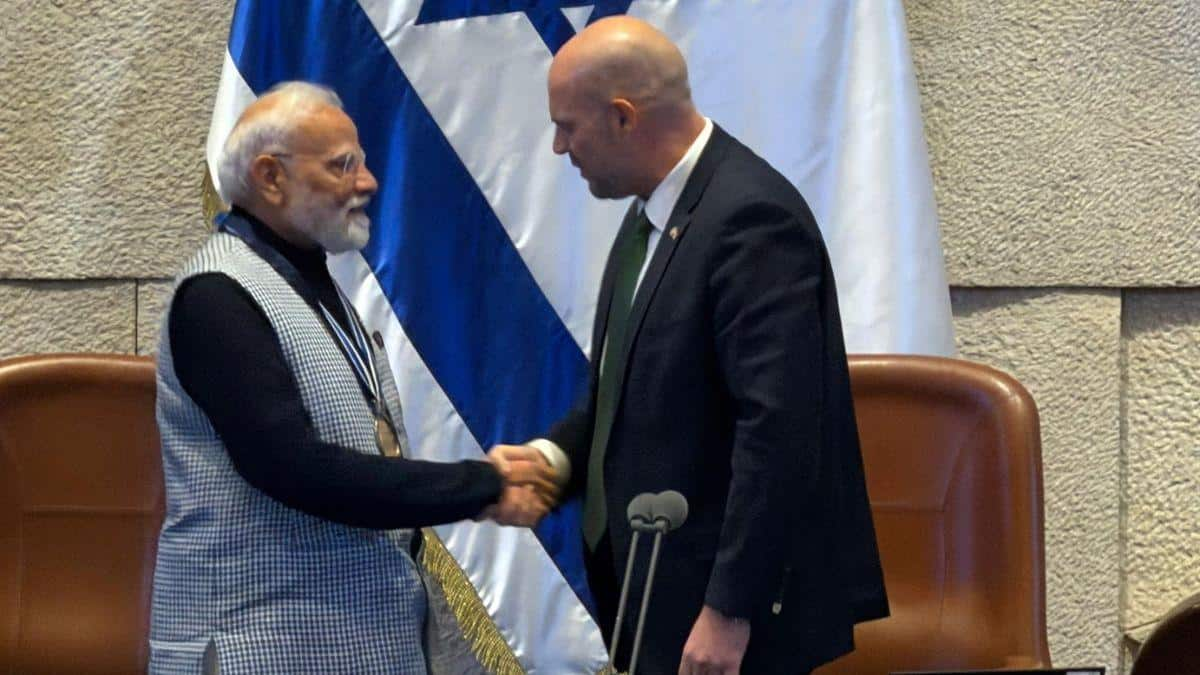
Prime Minister Narendra Modi was conferred the “Speaker of the Knesset Medal” by Israel’s Parliament on Wednesday, becoming the first Indian prime minister to receive the legislature’s highest honour. The medal was awarded in recognition of his exceptional contribution to strengthening strategic ties between India and Israel. He is the first recipient of the medal, the highest honour conferred by the Knesset. Among Few Leaders Honoured By Israel And Palestine Modi is among the few global leaders to have received top civilian honours from both Israel and Palestine. In 2018, he was conferred the Grand Collar of the State of Palestine, the highest Palestinian award granted to foreign dignitaries. Netanyahu’s Warm Welcome Earlier, Israeli Prime Minister Benjamin Netanyahu welcomed Modi ahead of his address to the Knesset, describing him as “a great friend of Israel, a great champion of the Indian-Israeli alliance, a great leader on the world stage.” “I have to tell you, Narendra, my dear friend, I am deeply, deeply moved by your visit here today. I've never been more moved than by your visit here with us, a great friend of Israel, a great champion of the Indian-Israeli alliance, a great leader on the world stage. Welcome to Jerusalem, my dear friend, Prime Minister Narendra Modi and your distinguished delegation,” he said. He added: “I would almost venture to say, more than a friend, a brother. Now, when you were last here, we, the two of us, were on the Mediterranean coast, and I said, why don't we take off our shoes and go into the water?... We didn't walk on water, but we did perform miracles since then. Because what we have done is we've doubled our trade, tripled our cooperation, quadrupled our understanding.” Expanding Strategic Partnership The honour highlights the growing partnership between India and Israel across defence, cybersecurity, agriculture, water management and innovation. Bilateral ties have expanded significantly over the past decade through high-level political exchanges, rising trade and collaboration in emerging technologies. Modi’s engagement with Israeli leaders and lawmakers during the visit underscored a shared emphasis on security cooperation, investment and people-to-people ties. Observers view the award as symbolic of the steady elevation of India–Israel relations into a broad-based strategic partnership marked by converging regional and global interests.