These terms and conditions apply to the News Hunt app (hereby referred to as "Application") for mobile devices that was created by (hereby referred to as "Service Provider") as an Ad Supported service.
Upon downloading or utilizing the Application, you are automatically agreeing to the following terms. It is strongly advised that you thoroughly read and understand these terms prior to using the Application. Unauthorized copying or modification of the Application, any part of the Application, or our trademarks is strictly prohibited. Any attempts to extract the source code, translate the Application into other languages, or create derivative versions are not permitted. All intellectual property rights remain the property of the Service Provider.
The Service Provider is dedicated to ensuring the Application is as beneficial and efficient as possible. They reserve the right to modify the Application or charge for services at any time and for any reason. Any such charges will be clearly communicated.
The Application stores and processes personal data provided by you. You are responsible for maintaining the security of your device and access to the Application. Jailbreaking or rooting your device is strongly discouraged as it may compromise security and application performance.
Third-Party Services
The Application uses third-party services that have their own Terms and Conditions. Refer to the following links:
Google Play Services
AdMob
Google Analytics for Firebase
Firebase Crashlytics
Limitations and Responsibilities
Some Application functions require an internet connection (Wi-Fi or mobile data). The Service Provider is not responsible if the Application does not function fully due to lack of access or depleted data. If using the Application outside a Wi-Fi area, you accept responsibility for any charges incurred, including roaming fees. If you are not the bill payer, it is assumed you have obtained permission.
It is your responsibility to keep your device charged. The Service Provider is not responsible if the device is unavailable due to a drained battery.
While the Service Provider strives to keep the Application updated and accurate, they rely on third-party data and do not accept liability for losses caused by reliance on Application functionality.
Updates and Termination
The Application may be updated to remain compatible with the operating system. You agree to install updates as offered. The Service Provider may discontinue the Application at any time without notice. Upon termination:
Rights and licenses granted to you will end.
You must stop using the Application and delete it from your device.
Changes to These Terms and Conditions
The Service Provider may update these Terms and Conditions periodically. Please review this page regularly. Changes will be posted on this page.
Effective Date: 2025-05-19
Contact Us
If you have questions or suggestions about the Terms and Conditions, contact the Service Provider at: 📧 info@infinitietech.com
India may have secured relief from some of Washington's earlier tariff measures, but the threat of fresh US trade action is far from over.
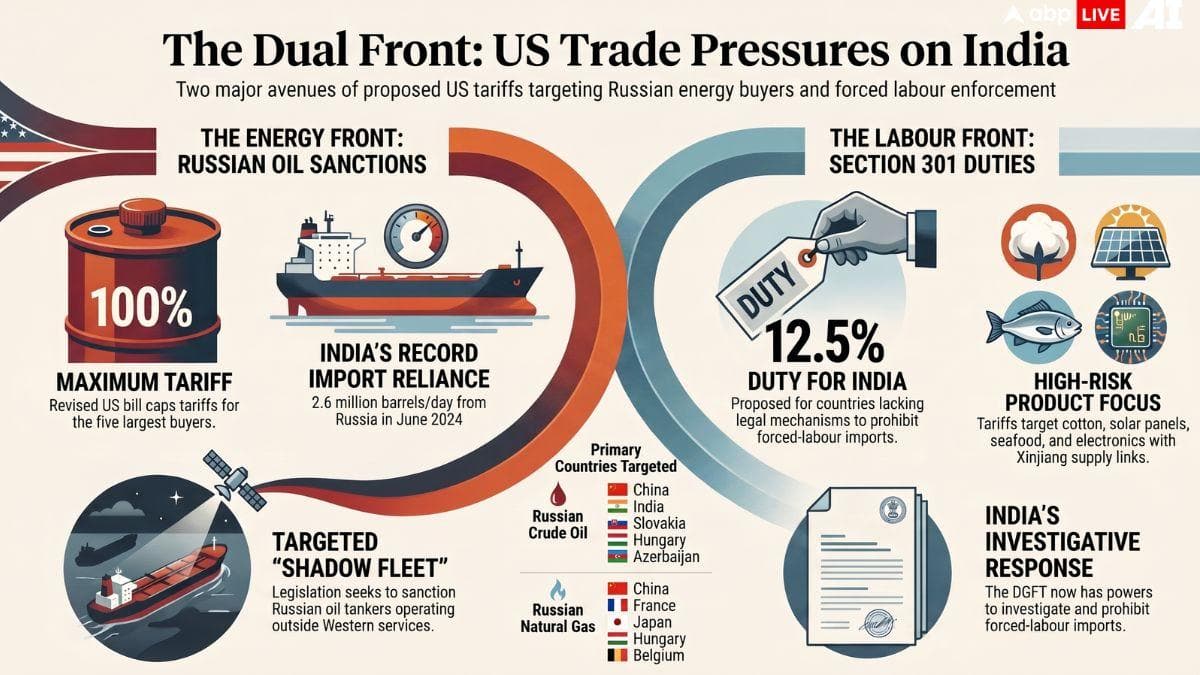
A revised Russia sanctions bill in the United States has lowered a proposed tariff on countries buying Russian energy from as much as 500 per cent to a maximum of 100 per cent. However, India remains firmly in focus as one of the world's biggest buyers of Russian crude oil.
Russian Oil Buyers Face Up To 100% Tariff Under Revised Bill
A bipartisan group of Republican and Democratic senators in the US has introduced a revised Russia sanctions bill aimed at increasing economic pressure on Moscow, reported The Financial Express.
One of the biggest changes in the latest proposal is the reduction of the maximum tariff targeting buyers of Russian energy.
The earlier version proposed tariffs of up to 500 per cent on third-party countries knowingly purchasing Russian oil, natural gas, uranium or other petroleum products. The revised legislation limits the maximum tariff to 100 per cent and narrows its application to the five biggest buyers of Russian oil and natural gas.
According to Senate aides, the five largest buyers of Russian crude oil are China, India, Slovakia, Hungary and Azerbaijan. China, France, Japan, Hungary and Belgium are among the largest importers of Russian natural gas.
The revised bill also provides an exemption for countries importing less than 15 per cent of Russia's natural gas exports and making serious efforts to reduce those purchases. The exception could apply to Japan, France, Hungary and Belgium.
India Remains In Focus Over Russian Crude Purchases
The proposed sanctions come as India continues to rely heavily on Russian crude.
According to energy tracking company Kpler, India imported a record 4.93 million barrels of crude oil per day in June despite heightened geopolitical tensions in West Asia.
Russian oil imports climbed to around 2.6 million barrels per day after declining in May, once again making Moscow India's largest crude supplier. Kpler data showed that Russian crude accounted for more than half of India's total oil imports during June.
Indian refiners had increased purchases of discounted Russian crude after European demand weakened following the Ukraine war.
Kpler analyst Sumit Ritolia told PTI that Indian refiners have already secured most of their crude supplies through the first half of August, as oil cargoes are generally booked one or two months in advance.
This means refiners are unlikely to immediately make significant additional purchases even if geopolitical tensions persist.
The original sanctions proposal was introduced in April 2025 by Republican Senator Lindsey Graham and Democratic Senator Richard Blumenthal of Connecticut.
The earlier draft proposed some of the toughest secondary sanctions considered by Washington, allowing tariffs of up to 500 per cent on goods and services from countries knowingly purchasing Russian energy products.
The revised legislation is different.
According to Senate aides cited by Reuters, the changes followed months of discussions with the White House aimed at securing US President Donald Trump's support for the legislation.
“This is the only product that currently has buy-in from everybody and is likely the only product that is going to move forward and put pressure on Russia the way we would all like to get,” an aide said, according to Reuters.
The legislation has 26 co-sponsors, with Senate aides expecting more lawmakers to support the proposal.
Trump Gets Power To Temporarily Waive Sanctions
The proposed legislation goes beyond tariffs on buyers of Russian energy.
It seeks sanctions against Russia's shadow fleet of oil tankers, which operates without relying on Western shipping services. Russian financial institutions, including the Central Bank of the Russian Federation, are also targeted.
The bill further proposes action against major Russian state-owned energy projects, including Yamal LNG and Arctic LNG 1, 2 and 3.
Another significant provision allows Trump to temporarily waive sanctions if he believes such a move is in the national interest of the United States.
Trump has also suggested adding sanctions linked to Iran and Hezbollah to the legislation.
However, Blumenthal urged lawmakers against expanding the bill to additional targets.
“With all due respect to the president, he has approved this bill, and we should move forward with this bill rather than opening it, in my view, to other potential targets,” Blumenthal told reporters.
Trump, meanwhile, said he believed the legislation had a strong chance of clearing Congress.
“This is in honour of Lindsey. This was his thing. He wanted this more than anything. You know how he felt, and there’s a good chance that it gets done,” Trump said.
Forced Labour Probe Opens Another Tariff Front For India
Russian oil is not the only source of tariff pressure for India.
Washington has already proposed additional duties of up to 12.5 per cent on Indian goods over concerns regarding the enforcement of restrictions on imports of products made with forced labour.
The Office of the US Trade Representative (USTR), in a report released in early June, examined the enforcement of forced-labour import prohibitions across 60 countries, including members of the European Union.
The USTR said India's failure to impose and effectively enforce a forced-labour import prohibition was unreasonable and burdened or restricted US commerce.
While the US trade authority found enforcement shortcomings across all countries examined, economies with existing laws or rules were treated differently from those without a legal mechanism.
The USTR proposed additional duties of 10 per cent on Canada, Ecuador, the European Union, Indonesia, Mexico and Pakistan, which had laws but were found to lack effective enforcement.
For the remaining 54 countries, including India, which the USTR said lacked a legal mechanism on forced-labour imports, duties of 12.5 per cent were proposed.
India Moves To Strengthen Forced Labour Import Rules
India has since issued detailed guidelines aimed at identifying goods produced using forced labour.
Through a Trade Notice, the Directorate General of Foreign Trade (DGFT) inserted a paragraph in the Handbook of Procedures of the Foreign Trade Policy, empowering the authority to initiate an investigation either on its own or after receiving a complaint.
The investigation can examine whether goods imported into India have been produced fully or partially using forced labour.
“India’s notification signals that it is strengthening its domestic legal framework in line with international standards, a step that could strengthen its position in future trade negotiations and market-access discussions,” Global Trade Research Initiative (GTRI) founder Ajay Srivastava said.
For an inquiry, the DGFT has been empowered to seek information, documents or clarifications from importers, exporters, manufacturers, expert bodies and international organisations.
Based on its investigation, the DGFT can recommend prohibiting such imports.
Cotton, Solar Panels And Electronics Among Products Under Focus
According to Srivastava, US authorities consider several products vulnerable to forced-labour risks.
These include cotton, textiles, solar-panel polysilicon, seafood, metals, batteries and electronics, particularly when supply chains are linked to China's Xinjiang region.
The USTR is currently holding consultations with stakeholders before deciding the final level of duties to be imposed on the 60 countries examined.
The forced-labour investigation was conducted under Section 301 of the US Trade Act.
“The priority should be to build credible traceability and due-diligence systems that protect legitimate trade while ensuring that forced-labour rules do not become arbitrary non-tariff barriers,” Srivastava said.
US Is Building A Fresh Tariff Architecture
A separate Section 301 investigation into policies supporting excess manufacturing capacity in key trading economies is also underway.
These investigations form part of the US government's effort to create a fresh tariff framework after the US Supreme Court struck down Trump's broad reciprocal tariffs.
The new additional tariffs could eventually form the basis of future trade negotiations conducted by Washington.
The revised Russia sanctions bill will now move through the US Congress for debate and voting. India has not yet issued a detailed response to the latest proposal. New Delhi has previously defended its Russian oil purchases on the grounds of national interest and energy security.