These terms and conditions apply to the News Hunt app (hereby referred to as "Application") for mobile devices that was created by (hereby referred to as "Service Provider") as an Ad Supported service.
Upon downloading or utilizing the Application, you are automatically agreeing to the following terms. It is strongly advised that you thoroughly read and understand these terms prior to using the Application. Unauthorized copying or modification of the Application, any part of the Application, or our trademarks is strictly prohibited. Any attempts to extract the source code, translate the Application into other languages, or create derivative versions are not permitted. All intellectual property rights remain the property of the Service Provider.
The Service Provider is dedicated to ensuring the Application is as beneficial and efficient as possible. They reserve the right to modify the Application or charge for services at any time and for any reason. Any such charges will be clearly communicated.
The Application stores and processes personal data provided by you. You are responsible for maintaining the security of your device and access to the Application. Jailbreaking or rooting your device is strongly discouraged as it may compromise security and application performance.
Third-Party Services
The Application uses third-party services that have their own Terms and Conditions. Refer to the following links:
Google Play Services
AdMob
Google Analytics for Firebase
Firebase Crashlytics
Limitations and Responsibilities
Some Application functions require an internet connection (Wi-Fi or mobile data). The Service Provider is not responsible if the Application does not function fully due to lack of access or depleted data. If using the Application outside a Wi-Fi area, you accept responsibility for any charges incurred, including roaming fees. If you are not the bill payer, it is assumed you have obtained permission.
It is your responsibility to keep your device charged. The Service Provider is not responsible if the device is unavailable due to a drained battery.
While the Service Provider strives to keep the Application updated and accurate, they rely on third-party data and do not accept liability for losses caused by reliance on Application functionality.
Updates and Termination
The Application may be updated to remain compatible with the operating system. You agree to install updates as offered. The Service Provider may discontinue the Application at any time without notice. Upon termination:
Rights and licenses granted to you will end.
You must stop using the Application and delete it from your device.
Changes to These Terms and Conditions
The Service Provider may update these Terms and Conditions periodically. Please review this page regularly. Changes will be posted on this page.
Effective Date: 2025-05-19
Contact Us
If you have questions or suggestions about the Terms and Conditions, contact the Service Provider at: 📧 info@infinitietech.com
Income tax return season can bring with it a familiar question for salaried taxpayers: Do I really need a chartered accountant to file my ITR?
For those with relatively straightforward income and tax affairs, filing a return independently has become increasingly accessible. The Income Tax Department's e-filing system now offers online filing and pre-filled information, reducing at least some of the manual work involved in preparing a return.
For Assessment Year 2026-27, ITR-1, ITR-2, ITR-3 and ITR-4 are live on the Income Tax Department's e-filing portal, with online and offline filing options enabled.
However, easier does not mean automatic. Taxpayers still need to choose the correct ITR form, reconcile the information available with the tax department and report income accurately.
So, if you are planning to file your ITR without a CA, where should you begin?
First Things First: Get Your Tax Papers Together
Before logging into the tax portal, it helps to collect all the information you may need.
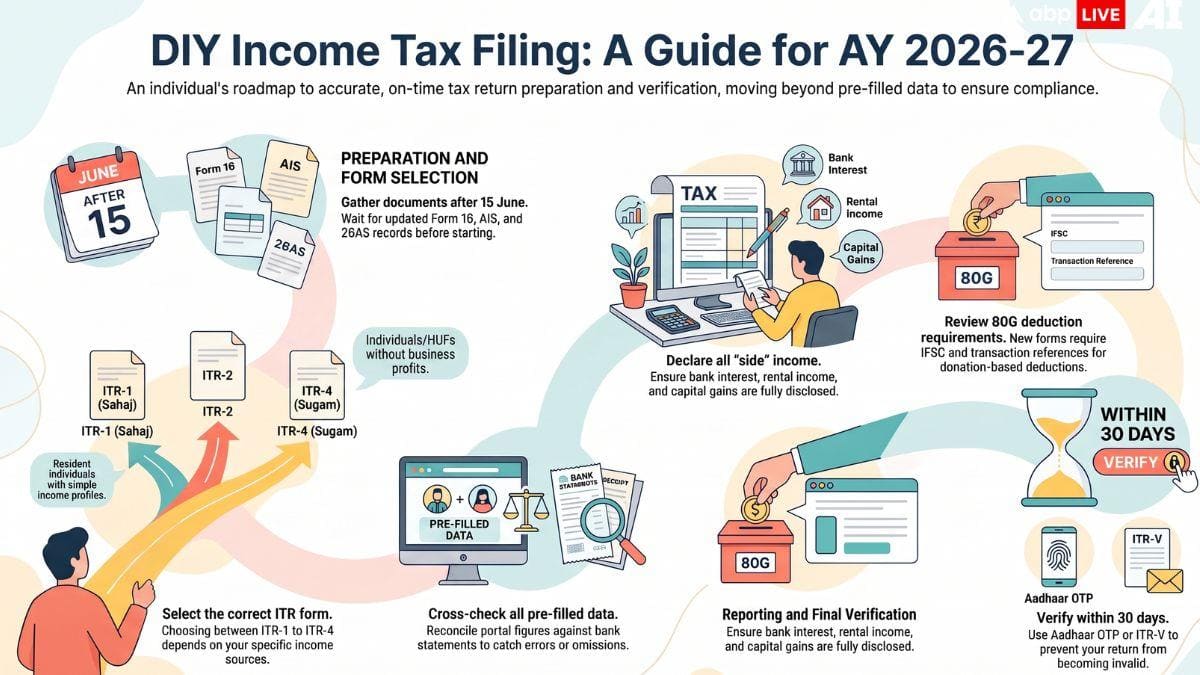
For a salaried taxpayer, this could include Form 16, salary details and bank statements. Form 26AS and the Annual Information Statement, or AIS, are also important for checking tax and income information available with the Income Tax Department.
Depending on your financial situation, you may also need details of capital gains, interest income, rental income and home loan interest. Documentary records relating to deductions and exemptions claimed in the return should also be kept ready.
Tax experts advise taxpayers to wait until after June 15 for greater accuracy as Form 16, AIS and Form 26AS information is generally updated by around this period.
Even if information appears in a pre-filled return, it is important to cross-check the figures against your own records.
The next step is to access the Income Tax Department's e-filing portal and log in to your account.
Taxpayers filing independently can use the portal to begin the return-filing process and select the relevant assessment year and filing mode.
For AY 2026-27, the Income Tax Department has enabled ITR-1, ITR-2, ITR-3 and ITR-4 for filing.
The online filing route can be particularly useful for taxpayers with simpler returns as several pieces of information may already be populated in the form.
But there is a catch: pre-filled does not mean error-proof.
Picking The Right ITR Form Is Crucial
One of the first decisions taxpayers face is selecting the correct income tax return form.
The applicable form depends on factors including the taxpayer's income sources, total income and financial circumstances.
ITR-1, commonly known as Sahaj, is meant for eligible resident individuals with relatively simple income profiles. ITR-2 generally applies to individuals and Hindu Undivided Families who are not eligible to file ITR-1 and do not have income from profits and gains of business or profession.
ITR-3 is relevant for individuals and HUFs with income from business or profession, while ITR-4, or Sugam, is available to eligible taxpayers reporting income on a presumptive basis under specified provisions.
Selecting the wrong form can complicate the filing process, making this one step where taxpayers should pay close attention to eligibility conditions.
AIS And Form 26AS Need A Careful Look
Once the return is open, resist the temptation to simply accept every pre-filled figure and move on.
The Annual Information Statement can contain information relating to financial transactions and income reported to the tax department. Form 26AS, meanwhile, is important for reviewing tax credits and other tax-related information.
Taxpayers are cautioned against relying entirely on pre-filled information. An income item not appearing in the AIS or pre-filled return does not automatically remove the taxpayer's responsibility to report it.
This means salary may be the starting point, but it may not be the whole story.
Interest income from savings accounts or deposits, rental income, capital gains and income from other sources may also need to be disclosed, depending on the taxpayer's circumstances.
Don't Forget That Side Income
This is one area where filing independently demands attention.
A taxpayer may think primarily in terms of salary while preparing an ITR, but income can come from several sources.
Bank interest, fixed deposits, rent, investments and capital gains may all have tax-reporting implications. Income from freelance or professional activities may also affect the return form and reporting requirements.
Taxpayers with foreign income or assets can face additional disclosure requirements and should carefully examine whether a simple self-filed return is appropriate for their situation.
The key is to reconcile your actual income and financial records instead of assuming that every taxable item will automatically appear on the portal.
Check Your Deductions Before Claiming Them
Tax deductions are another area where taxpayers need to avoid a copy-and-paste approach.
Depending on the tax regime and eligibility conditions applicable to the taxpayer, deductions may be available under various provisions of income tax law.
Claims must be supported by accurate information and taxpayers should retain the relevant documentary records.
There are also changes in the AY 2026-27 ITR forms that taxpayers should review before filing. For instance, The Economic Times reported that those claiming a deduction under Section 80G are required to provide additional information, including the IFSC and transaction reference number relating to the donation.
The broader lesson is simple: do not claim a deduction merely because you claimed it in an earlier return. Check the current form, your chosen tax regime and the applicable eligibility requirements.
Preview The Return Before You Hit Submit
Once income, deductions and tax details have been entered, the return should be reviewed carefully.
It is recommedned to check the tax liability or refund amount, whether TDS credits from employers and banks have been correctly considered and whether advance tax or self-assessment tax payments are reflected.
Bank account details are particularly important where a refund is expected.
A final review can also help identify missing income, incorrect personal details or discrepancies between the return and the taxpayer's records.
If the tax computation shows an amount payable, the portal provides options to deal with the tax liability during the filing process.
Filing Is Not The End, You Still Need To Verify Your ITR
Submitting an income tax return is only part of the process.
Taxpayers choosing e-verification must complete the verification process within 30 days of filing the return, according to the Income Tax Department's filing framework.
The return can be e-verified through available methods on the tax portal. Depending on eligibility and the option selected, these include Aadhaar OTP and other electronic verification routes.
Taxpayers unable to use the electronic route can follow the applicable process for physical verification through ITR-V.
Skipping verification can leave the return incomplete, making this a crucial final step.
For a salaried taxpayer with straightforward income, filing an ITR independently may be manageable, particularly with pre-filled information and the online filing facility.
The situation can become considerably more complicated where a taxpayer has complex capital gains, business or professional income, foreign assets or foreign income, or other transactions involving detailed tax reporting.
In such cases, professional advice may help reduce the risk of incorrect reporting.
Filing ITR Yourself? Accuracy Matters More Than Speed
The growing use of pre-filled information has made tax filing more accessible, but taxpayers remain responsible for the information submitted in their returns.
For those filing without a CA, the process is less about rushing through the portal and more about three basic checks: choosing the correct ITR form, matching tax information with personal records and declaring all applicable income.
The technology may now do part of the paperwork. The final responsibility for getting the return right, however, still rests with the taxpayer.